Why do I read research papers?
August 13, 2026
The old wisdom was that a part of a researcher’s job is to read papers. The new wisdom questions whether a researcher really needs to read papers. It is easy to upload an article to Claude or ChatGPT to get a summary of the key contributions. Armed with this knowledge, a researcher can focus on the problems they care about.
The goal of doing research is, after all, to advance our understanding of something out there. AI assistants can accelerate this process. We would not need to read every paper written on the topic. We can just find papers relevant to our work (perhaps, with an assistant), feed them into the assistant, and ask it to digest them. Then, instead of spending the time actually reading the papers, we can just read the pre-cooked digest.
I love the vision. But I still like reading papers.
Our models are excellent at synthesizing the key points from text. But I want more than a summary of the information in the paper. I want an interpretation of the paper. To be more precise, I want my interpretation of the paper. Let me elaborate.
Understanding is not the same as interpretation. Understanding a paper, especially in a technical area, focuses on the core contributions and findings. Barring unusual circumstances, people would generally agree on these. If a paper in widget-ology shows that widgets of type 1 are more energy efficient than widgets of type 2, then that represents the facts of the case. A good summary of the paper would say so.
When ChatGPT synthesizes a paper, it reaches for a summary. It can even dive deeper into the technical details than the paper itself does. Is the summary neutral though? Facts can be seen through a certain lens. The widget-ologist who architected type 1 may focus on the headline result, while the one who made type 2 might quibble about the evaluation quality. The popular media might focus on the needless energy that both widgets consume. A mathematician may realize that they can analytically explain the findings and that might even lead to the mathematical foundations of widgets. An economist may argue that type 2 widgets lead to job loss.
Whose lens does the AI assistant use to examine the facts? That is, whose interpretation of the facts are we getting in the summary if we do not explicitly ask it to use a certain persona?
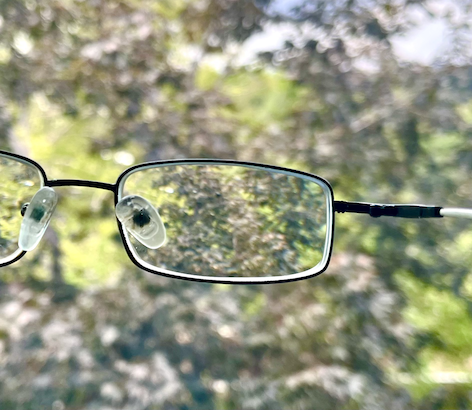
Nothing out there resolves until it passes through a lens
I want the perspective that I get when I read a paper through the lens of my experiences, my understanding of the technical landscape, my previous readings, my personal biases, failings and preferences, and my taste in problems and solutions. All these and more end up coloring how I interpret the core ideas in papers I read and also any incidental information that may be in them. My interpretation does not exist out there waiting for me to find it. It is formed by the act of my reading the paper, built from the material in the paper along with what I bring to it.
By removing the ability to interpret, the summary forces a certain interpretation on me. But the nuances of my personal lenses help make new connections and spark new ideas. Even bad papers and papers I dislike sometimes do this. If I were to sacrifice the personal perspective, I would be left at the mercy of the model’s summary and its interpretation.
To be fair, I might end up liking that interpretation. I might even end up agreeing with it.1 But that is not the point. What I lose, or at least impoverish, is my own privileged view of the world. A view that is privileged to me because it is mine. Perhaps my viewpoint is uninteresting or unintelligible to you. But you have your own viewpoint.
So, why do I like reading papers?
If all I care about is understanding the contribution of a paper, then the LLM summary is good enough. Maybe for some papers, that is all I need. But when I read an LLM generated summary of the paper, I would collapse the space of interpretations into the one that the LLM produces. This collapse is irrevocable. I will never get back my own interpretation once I have seen the viewpoint that comes from outside.
Consider, as an analogy, books that are made into movies. If you watch the movie before reading the book, it is difficult to visualize different faces on the characters than the ones in the movie. I cannot unsee Anthony Hopkins as Hannibal Lecter, or Javier Bardem as Anton Chigurh.
My objection to the LLM generated summary is not about AI authorship at all. It applies to any secondary material, including textbooks and surveys, both of which I read. But LLMs are industrial strength summarizers that are easy to reach for, and do not need anyone to have ever read the paper. Human-authored summaries have authors and schools of thought I can push back against. What “school of thought” does the AI authored summary represent?
My concern is not whether I will understand the paper correctly if I read secondary material. The concern is whether I will keep being the person who has my views if I read only bland pre-digested text. The economist, the mathematician and the maker of widgets will all, over time, become the same. I would like my own interpretation of a paper before I reach for someone else’s. Or something else’s.
-
When I read an LLM generated piece, I am still going to interpret it from my perspective. But the source material is already compressed. The raw material for my reading/interpretation is already impoverished. ↩